What a Meme Coin Rug Pull Really Is and How to Spot It Before You Buy
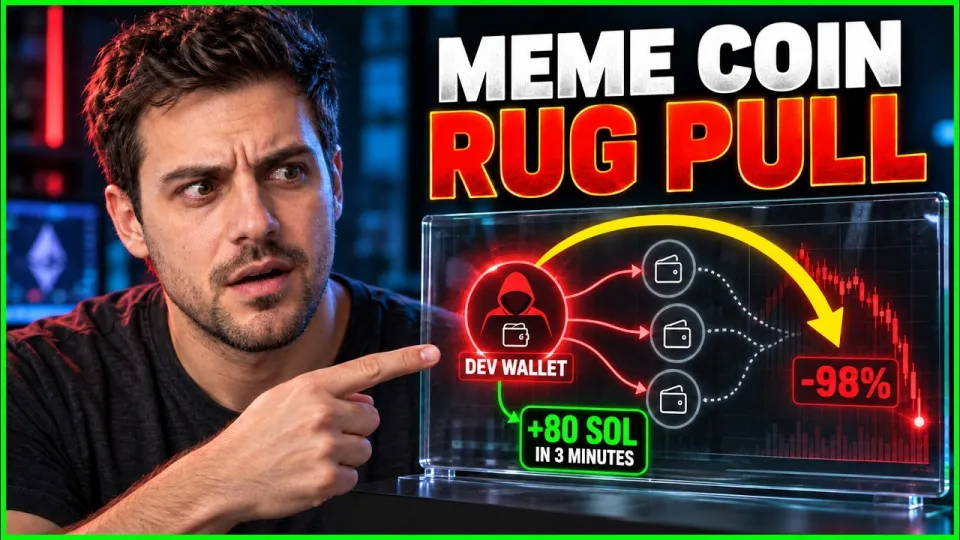
Video: Meme Coin Rug Pull - How it works using Pump Fun & SOL | Guide
· based on the channel SNNOW Crypto
A meme coin rug pull is a deliberate exit scam in which the people who control a token create demand, hide how much supply they own, and then sell into that demand, collapsing the price and leaving ordinary buyers holding worthless coins. It is not the same as a meme coin that simply fades because interest dried up. The difference is intent: a rug pull is planned deception by insiders, usually the creator and a small group of connected wallets.
If you want to see the launch mechanics used to set these traps up on Solana, the launcher shown in the SNNOW Crypto breakdown is available at memevault.buzz — the Pump Fun-style launch tool used in the video. Watching how a token is created is the fastest way to understand how it is later drained.
What a meme coin rug pull actually is
A rug pull is the coordinated removal of value from a token by the people who control it. The classic version works in four stages:
- A creator launches a token with a large share of supply routed to wallets the public cannot easily link together.
- Early trading and marketing create the appearance of organic demand, so the price chart looks like a real opportunity.
- New buyers enter because of the chart, the hype, or fear of missing out.
- The insider wallets sell in size, the price collapses, and liquidity that supported the market disappears.
The key detail is that the deception happens before the sale. Insiders do not need to break any rule to sell their own tokens. They only need buyers to believe the supply is fairly distributed when it is not. That is why a meme coin rug pull is an information problem first and a market event second.
How Pump Fun-style launches make rugs easy
Launchpads that let anyone create a token in a couple of minutes remove almost every barrier to a rug pull. On Solana, tools in the Pump Fun style let a creator mint a token, seed a small initial liquidity pool, and start trading immediately, with no audit, no team vetting and no disclosure requirements.
The same convenience that makes these launches fast also makes them dangerous:
- The creator decides the initial supply split, so a large allocation can sit in wallets that never appear in the public narrative.
- Bundling tools let one operator buy from many wallets in the same block, which disguises a single owner as a crowd of early believers.
- Liquidity can be thin, so a relatively small insider sale moves the price far more than holders expect.
- Trading fees and volume can be manufactured by wallets controlled by the same person, creating a chart that looks active but is not.
None of this means every launchpad token is a scam. It means the default assumption should be that control is concentrated until proven otherwise.
Warning signs of a meme coin rug pull
Most rugs leave visible traces before the crash. A practical checklist:
- One wallet or a small cluster holds a large share of supply. If the top ten holders control most of the token, the exit is a decision, not a risk.
- The creator wallet funded several early buyers. Follow the money: wallets funded from the same source at launch are usually one entity.
- Trading volume looks high but the holder count barely grows. That pattern points to wash trading between connected wallets.
- Liquidity is unlocked or controlled by the deployer. If the pool can be pulled at any moment, it eventually can be.
- The token has permissions that let the team mint more supply or change trading rules.
- Marketing pushes urgency. Countdowns, limited windows and aggressive shilling are designed to shorten the time you spend checking.
A single item on this list is not proof. Three or more together is a strong reason to walk away.
How to check holder distribution before buying
Holder distribution is the single most useful check available to a retail buyer. A block explorer or a holder-analysis dashboard shows the largest wallets, their percentage of supply, and when they acquired tokens.
What to look for:
- The top holder should not be an unexplained wallet holding a double-digit percentage of supply.
- Early buyers should have different funding sources, not one wallet feeding all of them.
- Holder count should grow alongside volume, not stay flat while volume spikes.
- Large holders should not all be sitting on unrealised profits at the same price level, because that is exactly where they will sell.
You are not trying to prove a token is safe. You are trying to find out whether one person can end the market with a single transaction. If the answer is yes, the upside does not compensate for the risk.
Telling a rug pull apart from a failed meme coin
Not every collapse is fraud. Meme coins fail for ordinary reasons too: attention moves on, early buyers take profit, liquidity stays too thin to absorb selling, or the team simply stops building. In those cases holders lose money, but nobody planned the loss.
The practical distinction comes down to what the insiders did. A failed meme coin usually shows a gradual decline as interest fades. A rug pull typically shows a sharp, coordinated exit by wallets that were funded together, held together, and sold together, often within minutes of a marketing push. If the supply was hidden and the exit was simultaneous, intent is the reasonable conclusion.
Common questions from new buyers
New traders tend to ask the same things, and the answers are usually simpler than expected. The most frequent doubts are about whether a token can be checked quickly, whether a low market cap means opportunity, and whether a giveaway or airdrop changes the risk profile. It does not: free tokens are a marketing cost, not a safety signal, and they are often used to inflate holder counts before an exit.
Another common question is whether a dev selling any tokens is automatically a rug. It is not. Teams sell for many reasons. The red flag is a sale of a hidden, concentrated allocation into liquidity that public buyers provided, especially when the sale is coordinated across wallets that were never disclosed.
Conclusion
A meme coin rug pull is planned deception, not bad luck, and it leaves evidence in the holder list, the funding history and the liquidity setup before it happens. Checking who owns the supply, how those wallets were funded, and whether the pool can be pulled takes only a few minutes and eliminates most of the tokens that end in a crash. Treat concentrated ownership as the default until you can prove otherwise, and treat urgency in marketing as a reason to slow down rather than speed up. The SNNOW Crypto breakdown walks through the same mechanics from the creator side, which is the most useful angle for anyone who wants to recognise the pattern early. If you want to inspect the launch tooling yourself, start at memevault.buzz and study how supply is split before a token ever reaches a chart.
Key takeaways
- A rug pull is deliberate deception by the team controlling a token, not just a token that loses value.
- Most Solana meme coin rugs run through Pump Fun-style launches where the creator keeps a large hidden supply.
- Bundled or connected wallets can hold most of the supply while the public sees a long list of small holders.
- Fake volume and paid hype pull in new buyers right before insider wallets exit into their liquidity.
- Checking holder distribution, creator wallet history and liquidity locks takes minutes and filters out most rugs.
Source: Meme Coin Rug Pull - How it works using Pump Fun & SOL | Guide · Markdown version
Questions & answers
What is a meme coin rug pull in simple terms?
It is a planned exit scam where the people controlling a token create demand, hide how much supply they own, and then sell into that demand. The price collapses and ordinary buyers are left with tokens nobody wants. The defining element is deliberate deception, not simply a token losing value.
Can I spot a rug pull before buying?
Often yes. Check the largest holders, see whether early buyer wallets were funded from the same source, and confirm whether liquidity is locked. If a small cluster controls most of the supply and can withdraw the pool, the risk is structural rather than theoretical.
Is every meme coin that drops to zero a rug pull?
No. Many tokens fail because attention fades, early buyers take profit, or liquidity is too thin to absorb selling. A rug pull involves insiders exiting a hidden, concentrated position in a coordinated way, usually shortly after a marketing push.
Do airdrops and giveaways make a meme coin safer?
No. Free tokens are a marketing expense and are often used to inflate the holder count so the distribution looks healthier than it is. They tell you nothing about who controls the supply or whether the liquidity can be removed.